

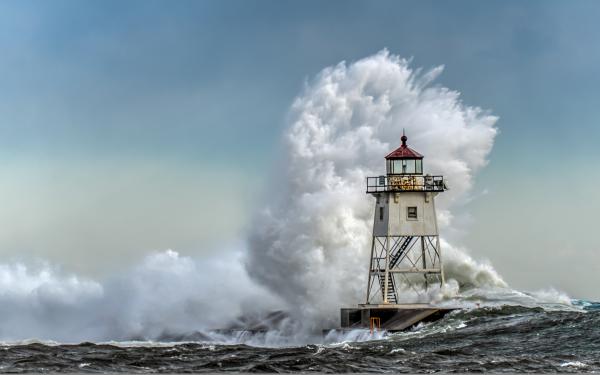
Beware the Gales of November
Fall is a tumultuous time of year along Minnesota’s North Shore. We’re battered by huge, icy swells that pommel our shoreline. Every day is a gamble. Will the Gales of November make it impossible to take to the water? Or will the lake be still as a sheet of glass? Every year, Lake Superior sees about 30 inches of precipitation, most of which falls May through October. Over the years, we’ve had some truly incredible storms pass through the region, wreaking havoc, sinking ships and making the news.
What Causes The Gales of November?

The Minnesota Sea Grant has conducted extensive research into why, exactly, so many epic storms develop around Lake Superior. It all has to do with climate, and what is going on in the air above the big lake. The experts explain that “collisions between belts of low and high pressure from the Gulf of Mexico and Canada generate the region's wildest storms and blizzards.”
In November, the winds really start to pick up around Lake Superior. This is caused by low-pressure systems passing over the lake, bringing on the Gales of November. During this time, wind speeds can easily reach 50 miles per hour, with gusts that can exceed 100 mph! For Cook County, this isn’t just dramatic weather — it’s part of what makes the destination unique.
Weather Watch: How to Spot the Gales of November and Plan Your Visit
When autumn storms gather over Lake Superior, a few classic meteorological signs can help you recognize when the legendary Gales of November are on the way. Watching these conditions can help visitors safely enjoy the spectacle — or prepare for rapidly changing weather on the North Shore.
1. Watch for Low-Pressure Systems from the Plains
Most gale events on Lake Superior form when a deep low-pressure system moves northeast out of the U.S. Great Plains or Colorado region. Look for pressure readings below 980 millibars (mb) or a rapid drop of more than 3 mb per hour — a strong indicator of a developing storm. These systems often track across northern Minnesota or southern Ontario, funneling strong winds directly across the open lake.
2. Southwest or Northeast Winds are the Most Wicked
Wind direction determines how waves build across Lake Superior’s 350-mile length.
- Southwest winds (blowing from Duluth toward Thunder Bay) generate massive waves along Cook County’s northeast-facing shoreline.
- Northeast winds (from Canada down the lake) can reverse the pattern, piling waves into Grand Marais and Lutsen bays.
Meteorologists often flag sustained winds above 35 knots (40 mph) with gusts over 50–60 knots (70 mph) as potential gale or storm-force events.
3. Watch for Sharp Temperature Drops and Variable Conditions
A hallmark of November gales is a rapid cold front following a warm, moist airstream from the south. When temperatures drop 15–25°F within hours, it signals vertical mixing — pulling stronger winds from aloft down to the lake’s surface. Sudden bursts of graupel, sleet, or heavy wet snow often accompany this transition.
4. Check for Marine Warnings on NOAA or Environment Canada
Before heading near the lake, check the NOAA Marine Forecast for Lake Superior or Environment Canada’s Great Lakes Weather Centre. Look for these specific alerts:
- Gale Warning: Sustained winds 34–47 knots (39–54 mph)
- Storm Warning: Sustained winds 48 knots (55 mph) or greater
- Freezing Spray Advisory: When arctic air moves in after the storm, coating shorelines and ships in ice
These forecasts are updated every 6 hours and include wind direction, wave height, and significant weather hazards — essential data for anyone near the lake or planning photography, hiking, or shoreline viewing.
5. Timing and Frequency
Historically, the highest gale frequency on Lake Superior occurs from late October through early December, when cold Arctic air first collides with lingering autumn warmth.
- Peak storm dates often fall between November 10 and 25 — coinciding with anniversaries of famous wrecks like the Edmund Fitzgerald (Nov 10, 1975).
- Average wave heights during strong gales can exceed 20–25 feet, with rogue waves surpassing 35 feet in open water.
Check out our Stormy Weather Playlist on YouTube for Storm Season inspiration
Shipwrecks on Lake Superior
Sailing the seas has long been one of the world’s riskiest and most dangerous professions. Years ago, shore dwellers knew that when a loved one went off to sea, they may not return. While the oceans, naturally, pose the biggest threat, Lake Superior is so vast it has claimed many ships into her cool depths. With weather that can change at the drop of a hat, Lake Superior has claimed hundreds of ships for her own.
Modern technology has made sailing and shipping on Lake Superior much safer, but she is still a mighty force to be reckoned with when the Gales of November rush through. Over the years, Lake Superior shipwrecks have dwindled, but there are a few notable wrecks near Cook County.
Notable Shipwrecks on Lake Superior near Grand Marais, Minnesota
The Wreck of SS Emperor - Isle Royale
On June 4, 1947, the iron ore carrier Emperor saw its last sunrise. When the 525-foot, 4,641-ton steamer rounded the northwest end of Isle Royale, it had near zero visibility. An overtired first mate caused her to run aground and crash into Canoe Rocks with such terrific impact that she split and sunk within 30 minutes. Twenty-one sailors were rescued by the Coast Guard that June day, but even with the quick response, 12 men tragically drowned when the Emperor sank.
The Wreck of SS Henry Steinbrenner - Isle Royale
In September of 2023, the wreck of the SS Henry Steinbrenner was discovered in 750 feet of water south of Isle Royale by a pair of Minnesota shipwreck-hunters. Lake Superior claimed 17 lives when the 427-foot Henry Steinbrenner went down on May 11, 1953. The iron ore carrier left Superior, Wisconsin on Sunday, May 10, under sunny 78-degree skies, but by the evening, the Steinbrenner was sailing through gale force winds upwards of 72 miles per hour, and 19-foot waves were pouring a dangerous amount of water into the hold. Throughout the night, the temperatures dropped dramatically, turning rain into driving snow and blinding the heavily-laden Steinbrenner. By morning, its fate was sealed and an abandon ship signal was blown by around 7:30am. Nearby ships were able to save 14 men, but 17 died, including the captain and first mate.
The Sinking of the SS America - Isle Royale
The SS America served as a communication and transport ship for the North Shore prior to Highway 61. On June 7, 1928 America arrived in Washington Harbor off the shore of Isle Royale and swiftly ran aground. Although the captain attempted to beach her, she hit a second reef, sunk, and remains there to this day. All aboard were safely rescued, including the captain’s dog. The wreckage can be seen today, as her hull lies only two feet below the surface of Superior--a haunting and unforgettable experience, one no visitor to Isle Royale will soon forget.
Lake Superior Facts & Info
By now, you’ve probably got Lake Superior on the mind. Don’t worry – it happens to all of us! The big lake holds stories, secrets and mysteries that are begging to be uncovered.
For all things Lake Superior, check out our free Lake Superior Facts & Info Guide. Discover all you ever wanted to know about our great lake – and more!